
Super Clone Watches Buying Guide
Last reviewed: August 2026
This super clone watches buying guide explains what can be checked before payment, what requires product-specific evidence, and which marketing claims should not be accepted without verification. Terms such as “1:1,” “Swiss,” “super clone,” and factory names are not independent quality standards. Evaluate the exact watch, seller terms, photographs, functions, and delivery process rather than relying on a label.
What “1:1 Super Clone” Does—and Does Not—Mean
“Super clone” is a market description, not a regulated grade. Different sellers can use the same label for watches with different movements, materials, dimensions, finishing, and functional layouts. A higher price or familiar factory name may provide context, but neither proves what is inside the watch being offered.
Replace broad promises with verifiable questions:
- What is the exact movement, and which functions operate?
- What are the measured case diameter or width, length, and thickness?
- Which components are steel, ceramic, titanium, composite, plated, coated, or decorative?
- Are the photographs of the exact configuration or shared catalog images?
- What happens if the delivered watch differs from the listing?
For terminology and quality-level differences, also read the super clone vs. replica comparison.
Start with Your Priorities, Not the Factory Label
Before comparing products, decide which factors actually matter to you. A visually complex chronograph or skeleton watch may require more checks and potentially more specialized servicing than a simple three-hand automatic. A large tonneau case can look impressive but may not fit a smaller wrist. A plated or coated finish may need more careful wear than an uncoated steel case.
- Daily wear: Prioritize comfort, clear time display, simple functions, bracelet or strap fit, and serviceability.
- Chronograph or GMT use: Verify the operation and adjustment of every hand, pusher, date, and subdial.
- Skeleton appearance: Distinguish visible movement components from decorative plates or bridges.
- Dive-watch styling: Inspect the bezel, crown, lume, and bracelet, but do not assume the printed depth rating is tested.
- Dress watch: Compare case thickness, lug shape, strap quality, dial alignment, and how the watch sits under a cuff.
1. Identify the Exact Reference and Configuration
Begin by matching the product title, photographs, selected options, SKU, and order confirmation. Similar watches may differ only by dial color, bezel, bracelet, strap, movement, or quality option, so a generic model name is not enough.
Record or screenshot the following before payment:
- Full product title, URL, SKU, selected quality level, and price
- Case size, thickness, dial color, bezel, bracelet or strap, and clasp
- Movement description and every claimed function
- Materials, coating, crystal, water-test statement, and included accessories
- Estimated QC, dispatch, delivery, warranty, and return timelines
If the product title, URL, images, and description refer to different colors or references, ask the seller to correct the listing before ordering.
2. Verify the Movement and Working Functions
The movement affects timekeeping, winding behavior, available functions, thickness, servicing, and long-term ownership. Do not assume that a movement decorated to resemble an authentic caliber has the same internal construction or performance.
Movement Information to Request
- Automatic, manual-wind, or quartz operation
- Actual movement designation rather than only the authentic caliber name
- Approximate power reserve and expected accuracy range
- Winding, time-setting, date-setting, and quick-set instructions
- Service availability and replacement-part limitations
Function Video to Request
The video should show the watch continuously rather than through multiple edited clips. For a chronograph, request start, stop, reset, and subdial operation. For GMT, calendar, moonphase-style, open-heart, or tourbillon-style models, ask the seller to demonstrate exactly what each display does.
A timegrapher image can provide a limited snapshot of rate, amplitude, and beat error for a mechanical watch, but it does not prove long-term reliability. Results can also vary by position and state of wind.
3. Confirm Materials Instead of Assuming Them
Material descriptions are frequently generalized across an entire collection. Verify each major component separately and ask whether the description refers to solid material, a surface treatment, or visual styling.
- Steel: Confirm whether the case and bracelet use stainless steel and whether a specific grade is documented.
- Gold color: Determine whether it is plating, PVD, another coating, or a gold-tone finish. Do not assume solid gold.
- Ceramic: Ask which component is ceramic. A ceramic-style bezel description does not prove the entire case is ceramic.
- Carbon or composite: Distinguish actual composite construction from a printed, molded, or coated carbon-style texture.
- Crystal: Confirm sapphire or mineral glass. A sapphire crystal does not mean the watch has a transparent sapphire case.
- Stones: Confirm whether decorative stones are simulated, lab-grown, or natural and whether documentation is included.
- Strap: Distinguish genuine exotic leather from embossed leather, synthetic material, or rubber.
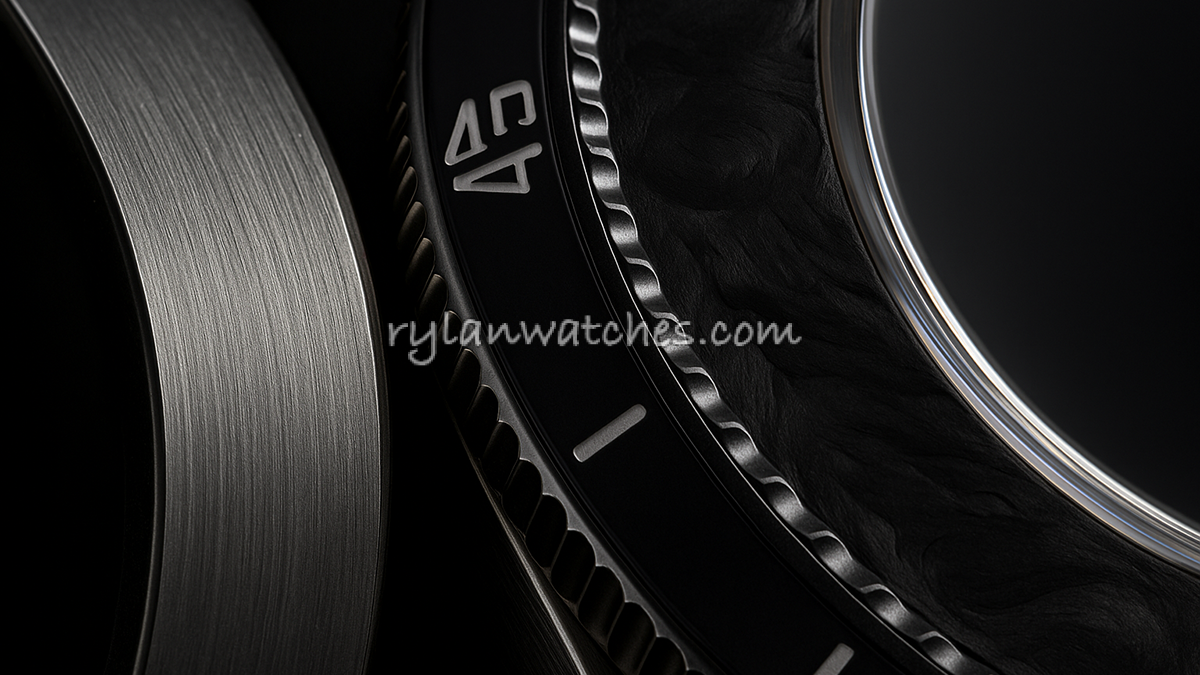
4. Compare the Full Dimensions and Wrist Fit
Case diameter is not enough to predict wearability. Ask for the width excluding the crown, vertical length or lug-to-lug measurement, thickness, bracelet or strap width, weight, and strap-hole range. Integrated bracelets, tonneau cases, long lugs, and thick chronograph cases can all change how a watch wears.
When possible, compare the measurements with a watch you already own. A current wrist photograph of the same configuration is more useful than a heavily cropped catalog image.
5. Review QC Photos and Videos Systematically
QC evidence is most useful when it shows the actual watch or exact configuration assigned to the order. Shared factory images can explain the design but cannot document the condition of the item being shipped.
Exterior QC Checklist
- Front view with the dial level and in focus
- Dial printing, markers, hands, date window, subdials, and visible dust
- Bezel alignment, insert, screws, crown, pushers, and case edges
- Both case sides, lugs, caseback, engravings, and crystal condition
- Bracelet links, end links, strap attachment, clasp, and spare links
- Lume photograph when luminous performance is part of the listing
Operation Checklist
- Winding and time-setting
- Date and calendar adjustment
- Chronograph start, stop, reset, and subdial movement
- GMT or additional hand adjustment
- Open-worked, tourbillon-style, or other visible mechanism in motion
- Clasp closure and bezel or crown operation where applicable
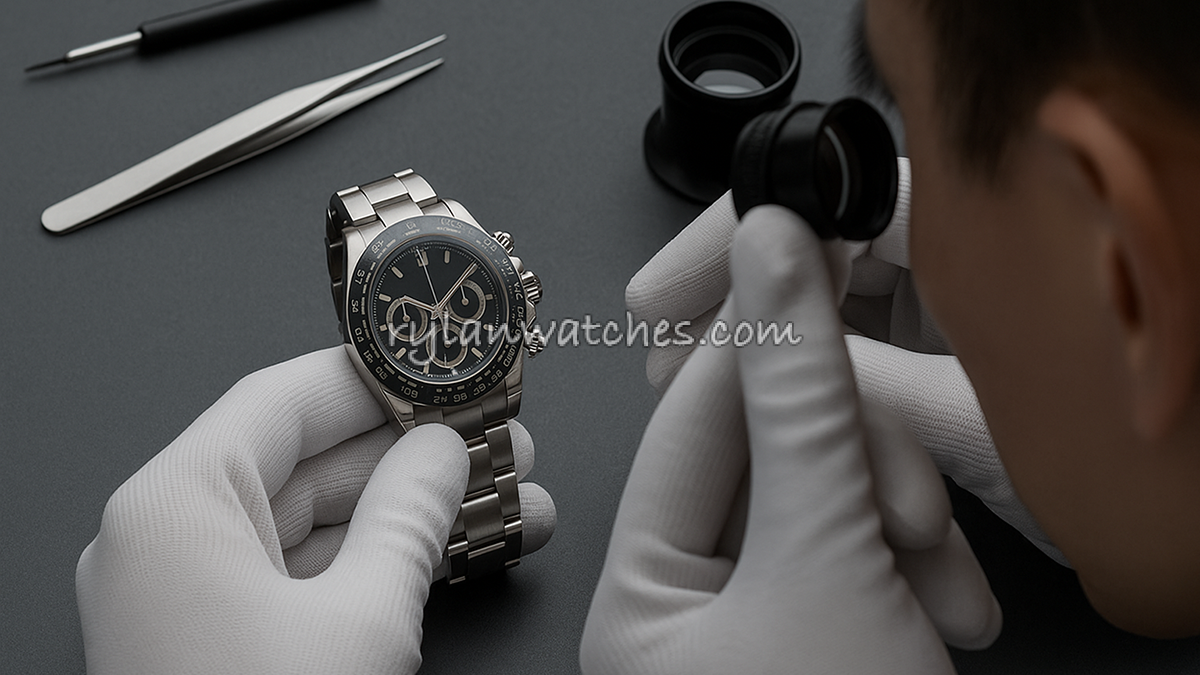
Use the complete replica watch QC guide when reviewing a seller’s photo and video set.
6. Evaluate the Seller and the Written Terms
A polished website, factory logo, testimonial, social-media account, or payment badge does not by itself establish reliability. Compare the seller’s stated process with what is provided during the order.
Positive Evidence to Look For
- Consistent business contact information and responsive communication
- Clear product-specific specifications rather than one description copied across many models
- Written QC, dispatch, tracking, warranty, return, exchange, and repair procedures
- Current photographs or video when requested
- An order confirmation that matches the selected product and options
Warning Signs
- Pressure to pay immediately or move the conversation to an unrelated account
- Guaranteed authenticity, guaranteed customs clearance, or guaranteed investment value
- Refusal to explain the movement, materials, functions, or return conditions
- Product title, photographs, SKU, description, and checkout details that do not match
- Copied reviews, only perfect ratings, or claims that cannot be connected to a specific transaction
For additional seller checks, read the replica watch website evaluation guide. Treat any list as a starting point and re-check the seller’s current terms before every order.
7. Check Payment, Shipping, Customs, and Destination Rules
Payment methods differ in reversibility, fees, identity requirements, and dispute options. Confirm the recipient details, currency, total cost, payment reference, and refund method before sending funds. Never assume that a payment method is safe merely because it is offered on a professional-looking checkout page.
For shipping, obtain the dispatch window, carrier or service type, tracking process, insurance terms, declared responsibility for customs issues, and the procedure for loss, damage, seizure, return-to-sender, or delivery to the wrong address.
Laws, import rules, and enforcement vary by destination and can change. Review the customs-risk guide and legal overview, then verify current rules with an appropriate local authority or qualified professional when the consequences matter.
8. Treat Water Resistance as Unverified Without a Test
A depth rating printed on the dial or copied from the authentic model does not establish the replica’s water resistance. Gaskets, crown tubes, crystal seating, caseback closure, assembly, age, and previous opening can all affect the result.
Do not swim, dive, shower, enter a sauna, or expose the watch to hot water unless the exact watch has passed an appropriate pressure test and the test scope is documented. Even after testing, seals can change over time and may need to be checked again after servicing or opening the case.
9. Inspect the Watch Immediately After Delivery
Record the unopened parcel and unboxing when practical, especially if the seller’s damage or discrepancy process requires evidence. Compare the delivered watch with the order confirmation and QC set before removing protective films, sizing the bracelet, or wearing it extensively.
- Check the model, color, case, dial, bezel, strap or bracelet, clasp, and included accessories.
- Inspect the crystal, dial, hands, case, coating, screws, bracelet, and clasp for damage or contamination.
- Test winding, time-setting, date, chronograph, GMT, calendar, and other listed functions.
- Observe timekeeping and power reserve without assuming one short test proves long-term performance.
- Report any discrepancy within the stated return or exchange period and keep the packaging and evidence.
Common Questions Before Buying
Is “1:1” a Standardized Quality Grade?
No. Sellers can use the term differently. Verify the individual watch’s movement, materials, dimensions, functions, photographs, and terms.
Does a Factory Name Prove the Origin or Quality?
No. Factory labels can be repeated or misused. Product-specific evidence and a consistent seller process are more useful than a name alone.
Do QC Photographs Guarantee a Problem-Free Watch?
No. They can reveal visible condition and some functional issues, but they cannot guarantee future reliability. Continuous video and clear return terms provide additional context.
Should a First-Time Buyer Choose a Complicated Watch?
A simpler three-hand or date watch is generally easier to inspect and service than a chronograph, calendar, skeleton, or tourbillon-style model. Choose complexity only when you understand how each function operates.
Does a Printed Water-Resistance Rating Prove the Watch Is Waterproof?
No. Only a suitable test performed on the exact watch can provide evidence of its current resistance, and no test guarantees permanent protection.
Where Can I Review More Questions?
See the super clone watches FAQ for additional information about movements, care, ordering, shipping, and realistic expectations.
Final Buying Checklist
A useful buying decision is based on evidence, not promises. Confirm the exact configuration, movement, functions, dimensions, materials, QC process, payment details, shipping responsibility, warranty, and return procedure. Save the listing and written confirmation, and inspect the delivered watch promptly.
The purpose of this super clone watches buying guide is not to identify one universal “best” factory or model. It is to help you compare products consistently, recognize missing information, and decide whether the available evidence and terms match your expectations and risk tolerance.
Trademark notice: Brand and model names referenced in this guide belong to their respective owners. Independently produced replicas are not manufactured, authorized, or endorsed by those brands.